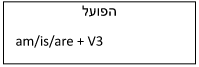
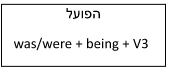
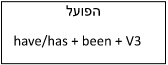
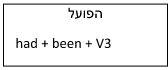
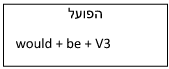
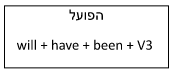
גוף +
+ by מישהו/משהו שמבצע את הפעולה
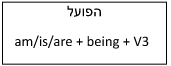
גוף +
+ by מישהו/משהו שמבצע את הפעולה
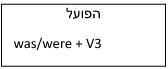
גוף +
+ by מישהו/משהו שמבצע את הפעולה
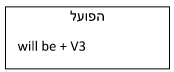
גוף +
+ by מישהו/משהו שמבצע את הפעולה
גוף +
+ by מישהו/משהו שמבצע את הפעולה
גוף +
+ by מישהו/משהו שמבצע את הפעולה
גוף +
+ by מישהו/משהו שמבצע את הפעולה
גוף +
+ by מישהו/משהו שמבצע את הפעולה
גוף +
+ by מישהו/משהו שמבצע את הפעולה
גוף +
+ by מישהו/משהו שמבצע את הפעולה
גוף +
+ by מישהו/משהו שמבצע את הפעולה
| ניחוח | aroma |
| לשייך | associate |
| קשות, באופן גרוע | badly |
| היה, נמצא | been |
| לנטור, לקנא | begrudge |
| חפצים אישיים | belongings |
| למצמץ | blink |
| אמיץ | bold (courageous) |
| חיזוק | boost |
| סיכוי | chance |
| דמות | character |
| נקי | clean |
| שחר | dawn |
| למטה | down |
| כדור הארץ, אדמה | earth |
| לעקוב | follow |
| מקורי, אמיתי | genuine |
| בחוסר התלהבות | halfhearted |
| רעב | hungry |
| אם | if |
| לסכן | jeopardize |
| חוק | law |
| גודל | magnitude |
| מטרה | objective |
| מסילת רכבת | railroad |
| מוכן | ready |
| דגימה | sample |
| להמריא | take-off |
| לחבל (בתחרות | tamper |
| בחמימות |
warmly |
רשימת פעלים יוצאי דופן
|
infinitive (v1) |
past simple (v2) |
Past Participle (V3) |
תרגום לעברית |
|
be |
was/were |
been |
להיות |
|
bear |
bore |
born |
לשאת/ללדת |
|
beat |
beat |
beaten |
להכות / לנצח |
|
become |
became |
become |
להיעשות / להיות ל |
|
begin |
began |
begun |
להתחיל |
|
bend |
bent |
bent |
להתכופף / לכופף |
|
bet |
bet |
bet |
להתערב |
|
bind |
bound |
bound |
לקשור |
|
bite |
bit |
bitten |
לנשוך |
|
bleed |
bled |
bled |
לדמם |
|
blow |
blew |
blown |
לנשוב / לפוצץ |
|
break |
broke |
broken |
לשבור |
|
bring |
brought |
brought |
להביא |
|
broadcast |
broadcast |
broadcast |
לשדר |
|
build |
built |
built |
לבנות |
|
burn |
burnt, burned |
burnt, burned |
לשרוף |
|
burst |
burst |
burst |
להתפוצץ |
|
buy |
bought |
bought |
לקנות |
|
catch |
caught |
caught |
לתפוס |
|
choose |
chose |
chosen |
לבחור |
|
come |
came |
come |
לבוא |
|
cost |
cost |
cost |
לעלות (מחיר) |
|
cut |
cut |
cut |
לחתוך |
|
deal |
dealt |
dealt |
לעסוק ב… |
|
dig |
dug |
dug |
לחפור |
|
do |
did |
done |
לעשות |
|
draw |
drew |
drawn |
לצייר / למשוך |
|
dream |
dreamt, dreamed |
dreamt, dreamed |
לחלום |
|
drink |
drank |
drunk |
לשתות |
|
drive |
drove |
driven |
לנהוג |
|
eat |
ate |
eaten |
לאכול |
|
fall |
fell |
fallen |
ליפול |
|
feed |
fed |
fed |
להאכיל |
|
feel |
felt |
felt |
להרגיש |
|
fight |
fought |
fought |
להילחם |
|
find |
found |
found |
למצוא |
|
flee |
fled |
fled |
לברוח |
|
fly |
flew |
flown |
לעוף / לטוס |
|
forbid |
forbade |
forbidden |
לאסור על |
|
forget |
forgot |
forgotten |
לשכוח |
|
forgive |
forgave |
forgiven |
לסלוח |
|
freeze |
froze |
frozen |
לקפוא / להקפיא |
|
get |
got |
got |
להשיג / לקבל |
|
give |
gave |
given |
לתת |
|
go |
went |
gone |
ללכת |
|
grow |
grew |
grown |
לגדול / לגדל |
|
hang |
hung, hanged |
hung, hanged |
לתלות |
|
have |
had |
had |
יש (שייכות) |
|
hear |
heard |
heard |
לשמוע |
|
hide |
hid |
hidden |
להחביא / להסתתר |
|
hit |
hit |
hit |
לפגוע |
|
hold |
held |
held |
להחזיק |
|
hurt |
hurt |
hurt |
לפגוע / להכאיב |
|
keep |
kept |
kept |
לשמור |
|
kneel |
knelt |
knelt |
לכרוע ברך |
|
know |
knew |
known |
לדעת |
|
lay |
laid |
laid |
להניח |
|
lead |
led |
led |
להוביל |
|
leave |
left |
left |
לעזוב |
|
lend |
lent |
lent |
להשאיל |
|
let |
let |
let |
להרשות |
|
lie |
lay |
lain |
לשכב |
|
light |
lit |
lit |
להדליק |
|
lose |
lost |
lost |
לאבד |
|
make |
made |
made |
לעשות / להכין |
|
mean |
meant |
meant |
להתכוון |
|
meet |
met |
met |
לפגוש |
|
mistake |
mistook |
mistaken |
לטעות |
|
pay |
paid |
paid |
לשלם |
|
put |
put |
put |
לשים |
|
quit |
quit |
quit |
לעזוב |
|
read |
read |
read |
לקרוא |
|
rid |
rid |
rid |
להיפטר |
|
ride |
rode |
ridden |
לרכב |
|
ring |
rang |
rung |
לצלצל |
|
rise |
rose |
risen |
לקום |
|
run |
ran |
run |
לרוץ |
|
say |
said |
said |
לומר |
|
see |
saw |
seen |
לראות |
|
seek |
sought |
sought |
לחפש |
|
sell |
sold |
sold |
למכור |
|
send |
sent |
sent |
לשלוח |
|
set |
set |
set |
לארגן |
|
sew |
sewed |
sewed |
לתפור |
|
shake |
shook |
shaken |
לרעוד |
|
shed |
shed |
shed |
לשפוך |
|
shine |
shined, shone |
shined, shone |
לזרוח |
|
shoot |
shot |
shot |
לירות |
|
shrink |
shrank |
shrunk |
להתכווץ |
|
shut |
shut |
shut |
לסגור |
|
sing |
sang |
sang |
לשיר |
|
sink |
sank |
sunk |
לשקוע |
|
sit |
sat |
sat |
לשבת |
|
sleep |
slept |
slept |
לישון |
|
speak |
spoke |
spoken |
לדבר |
|
spend |
spent |
spent |
לבלות / לבזבז |
|
spit |
spat |
spat |
לירוק |
|
split |
split |
split |
לחלק |
|
spread |
spread |
spread |
לפרוס |
|
spring |
sprang |
sprung |
לקפוץ |
|
stand |
stood |
stood |
לעמוד |
|
steal |
stole |
stolen |
לגנוב |
|
stick |
stuck |
stuck |
לדבוק |
|
sting |
stung |
stung |
לעקוץ |
|
stink |
stank |
stunk |
להסריח |
|
strike |
struk |
struk |
להכות/לשבות |
|
strive |
strove |
striven |
להיאבק למען, להתאמץ |
|
swear |
swore |
sworn |
להישבע |
|
sweep |
swept |
swept |
לטאטא |
|
swim |
swam |
swum |
לשחות |
|
swing |
swinged |
swung |
להתנדנד |
|
take |
took |
taken |
לקחת |
|
teach |
taught |
taught |
ללמד |
|
tear |
tore |
torn |
לקרוע |
|
tell |
told |
told |
לספר |
|
think |
thought |
thought |
לחשוב |
|
throw |
threw |
thrown |
לזרוק |
|
tread |
trod |
trodden |
לדרוך |
|
understand |
understood |
understood |
להבין |
|
upset |
upset |
upset |
להרגיז |
|
wake |
woke |
woken |
להעיר |
|
wear |
wore |
worn |
ללבוש |
|
weep |
wept |
wept |
לבכות |
|
win |
won |
won |
לזכות |
|
withdraw |
withdrew |
withdrawn |
לסגת |
|
write |
wrote |
written |
לכתוב |
0 of 15 questions completed
שאלות:
כבר השלמת את השאלון בעבר. לכן אינך יכול להתחיל אותו שוב.
השאלון נטען…
עליך להתחבר או להירשם כדי להתחיל את השאלון.
הזמן שלך:
זמן חלף
השגת 0 מתוך 0 נקודה(ות), (0)
נקודה(ות) שקיבלת: 0 מתוך 0, (0)
0 שאלות פתוחות בהמתנה (נקודה(ות) אפשרית(יות): 0)


1) The glass was broken by the Opera singer’s high pitch.
2) All the holiday plans were postponed last year due to the pandemic.
3) The rat was placed into a T-shaped maze in order to study its sense of direction and behavior.
4) The battle of Leyte Gulf in the Philippines, which occured on October 1944 during World War II, is considered to be the largest naval battle in history.
5) In most countries, all people are innocent of crime until enough evidence proves that they are guilty.
6) In most countries, the flag is lowered to half-mast during memorial ceremonies.
7) The Titanic sunk because mistakes were made by a lot of people- the engineers, the crew, and the captain.
8) According to United Nations estimates, Bulgaria’s population will shrink by more than 22% between 2020 and 2050, making it the fastest shrinking state in the world.
9) Urban Agriculture is the practice of growing, processing, and providing food in or around urban areas.
10) Although Mr. Middleton’s invitations were carried to a point of persistency beyond politeness, he still meant well.
At about 3 million square miles (7.7 million square km), Australia is the smallest continent on Earth. In fact, it’s closer in size to Greenland than it is to South America. Does that make Australia an island like Greenland? Although Australia is sometimes called an “island continent,” most geographers consider islands and continents to be separate things. According to Britannica, an island is a mass of land that is both “entirely surrounded by water” and also “smaller than a continent.” By that definition, Australia can’t be an island because it’s already a continent.
However, in that case, what’s the difference between Australia and Greenland? Why isn’t Greenland (at 836,000 square miles [2,165,230 square km]) considered a continent instead of just the world’s largest island? Unfortunately, there isn’t a strict scientific definition of a continent. But there are a few criteria that are commonly used to distinguish one continent from another.
First, there is a geological distinction. While Australia and most of Asia are situated on separate tectonic plates, Greenland shares a tectonic plate with North America. Second, there is a biological distinction. While a large percentage of Australia’s plant and animal species can be found nowhere else in the world, fewer of Greenland’s species are unique. Third, there is an anthropological distinction. Aboriginal people are limited to Australia, while indigenous Greenlanders belong to a group of peoples (the Inuit) found throughout the Arctic, including parts of Canada, the United States, and Russia.
While each of those criteria may not be sufficient on its own—for instance, Europe and Asia also share a tectonic plate but are usually considered separate continents for cultural reasons—together they form a general understanding of what qualifies as a continent. Of course, there’s also the basic matter of size. Australia is nearly four times as large as Greenland. If they were much closer in area, Greenland might have more of a case for continent status (and Australia for island status). As it is, the vast difference between the two makes for a good dividing line.
1) A fitting title for the text would be-
At about 3 million square miles (7.7 million square km), Australia is the smallest continent on Earth. In fact, it’s closer in size to Greenland than it is to South America. Does that make Australia an island like Greenland? Although Australia is sometimes called an “island continent,” most geographers consider islands and continents to be separate things. According to Britannica, an island is a mass of land that is both “entirely surrounded by water” and also “smaller than a continent.” By that definition, Australia can’t be an island because it’s already a continent.
However, in that case, what’s the difference between Australia and Greenland? Why isn’t Greenland (at 836,000 square miles [2,165,230 square km]) considered a continent instead of just the world’s largest island? Unfortunately, there isn’t a strict scientific definition of a continent. But there are a few criteria that are commonly used to distinguish one continent from another.
First, there is a geological distinction. While Australia and most of Asia are situated on separate tectonic plates, Greenland shares a tectonic plate with North America. Second, there is a biological distinction. While a large percentage of Australia’s plant and animal species can be found nowhere else in the world, fewer of Greenland’s species are unique. Third, there is an anthropological distinction. Aboriginal people are limited to Australia, while indigenous Greenlanders belong to a group of peoples (the Inuit) found throughout the Arctic, including parts of Canada, the United States, and Russia.
While each of those criteria may not be sufficient on its own—for instance, Europe and Asia also share a tectonic plate but are usually considered separate continents for cultural reasons—together they form a general understanding of what qualifies as a continent. Of course, there’s also the basic matter of size. Australia is nearly four times as large as Greenland. If they were much closer in area, Greenland might have more of a case for continent status (and Australia for island status). As it is, the vast difference between the two makes for a good dividing line.
2) In the first paragraph, Greenland is given as-
At about 3 million square miles (7.7 million square km), Australia is the smallest continent on Earth. In fact, it’s closer in size to Greenland than it is to South America. Does that make Australia an island like Greenland? Although Australia is sometimes called an “island continent,” most geographers consider islands and continents to be separate things. According to Britannica, an island is a mass of land that is both “entirely surrounded by water” and also “smaller than a continent.” By that definition, Australia can’t be an island because it’s already a continent.
However, in that case, what’s the difference between Australia and Greenland? Why isn’t Greenland (at 836,000 square miles [2,165,230 square km]) considered a continent instead of just the world’s largest island? Unfortunately, there isn’t a strict scientific definition of a continent. But there are a few criteria that are commonly used to distinguish one continent from another.
First, there is a geological distinction. While Australia and most of Asia are situated on separate tectonic plates, Greenland shares a tectonic plate with North America. Second, there is a biological distinction. While a large percentage of Australia’s plant and animal species can be found nowhere else in the world, fewer of Greenland’s species are unique. Third, there is an anthropological distinction. Aboriginal people are limited to Australia, while indigenous Greenlanders belong to a group of peoples (the Inuit) found throughout the Arctic, including parts of Canada, the United States, and Russia.
While each of those criteria may not be sufficient on its own—for instance, Europe and Asia also share a tectonic plate but are usually considered separate continents for cultural reasons—together they form a general understanding of what qualifies as a continent. Of course, there’s also the basic matter of size. Australia is nearly four times as large as Greenland. If they were much closer in area, Greenland might have more of a case for continent status (and Australia for island status). As it is, the vast difference between the two makes for a good dividing line.
3) The “geological distinction” mentioned in line 13 refers to-
At about 3 million square miles (7.7 million square km), Australia is the smallest continent on Earth. In fact, it’s closer in size to Greenland than it is to South America. Does that make Australia an island like Greenland? Although Australia is sometimes called an “island continent,” most geographers consider islands and continents to be separate things. According to Britannica, an island is a mass of land that is both “entirely surrounded by water” and also “smaller than a continent.” By that definition, Australia can’t be an island because it’s already a continent.
However, in that case, what’s the difference between Australia and Greenland? Why isn’t Greenland (at 836,000 square miles [2,165,230 square km]) considered a continent instead of just the world’s largest island? Unfortunately, there isn’t a strict scientific definition of a continent. But there are a few criteria that are commonly used to distinguish one continent from another.
First, there is a geological distinction. While Australia and most of Asia are situated on separate tectonic plates, Greenland shares a tectonic plate with North America. Second, there is a biological distinction. While a large percentage of Australia’s plant and animal species can be found nowhere else in the world, fewer of Greenland’s species are unique. Third, there is an anthropological distinction. Aboriginal people are limited to Australia, while indigenous Greenlanders belong to a group of peoples (the Inuit) found throughout the Arctic, including parts of Canada, the United States, and Russia.
While each of those criteria may not be sufficient on its own—for instance, Europe and Asia also share a tectonic plate but are usually considered separate continents for cultural reasons—together they form a general understanding of what qualifies as a continent. Of course, there’s also the basic matter of size. Australia is nearly four times as large as Greenland. If they were much closer in area, Greenland might have more of a case for continent status (and Australia for island status). As it is, the vast difference between the two makes for a good dividing line.
4) The Aboriginal people (line 17) are given as an example of-
At about 3 million square miles (7.7 million square km), Australia is the smallest continent on Earth. In fact, it’s closer in size to Greenland than it is to South America. Does that make Australia an island like Greenland? Although Australia is sometimes called an “island continent,” most geographers consider islands and continents to be separate things. According to Britannica, an island is a mass of land that is both “entirely surrounded by water” and also “smaller than a continent.” By that definition, Australia can’t be an island because it’s already a continent.
However, in that case, what’s the difference between Australia and Greenland? Why isn’t Greenland (at 836,000 square miles [2,165,230 square km]) considered a continent instead of just the world’s largest island? Unfortunately, there isn’t a strict scientific definition of a continent. But there are a few criteria that are commonly used to distinguish one continent from another.
First, there is a geological distinction. While Australia and most of Asia are situated on separate tectonic plates, Greenland shares a tectonic plate with North America. Second, there is a biological distinction. While a large percentage of Australia’s plant and animal species can be found nowhere else in the world, fewer of Greenland’s species are unique. Third, there is an anthropological distinction. Aboriginal people are limited to Australia, while indigenous Greenlanders belong to a group of peoples (the Inuit) found throughout the Arctic, including parts of Canada, the United States, and Russia.
While each of those criteria may not be sufficient on its own—for instance, Europe and Asia also share a tectonic plate but are usually considered separate continents for cultural reasons—together they form a general understanding of what qualifies as a continent. Of course, there’s also the basic matter of size. Australia is nearly four times as large as Greenland. If they were much closer in area, Greenland might have more of a case for continent status (and Australia for island status). As it is, the vast difference between the two makes for a good dividing line.
5) It can be inferred from the last paragraph that the writer believes that-
כל המידע לרבות שם המשתמש לא יהיה גלוי ללומדים האחרים למעט צוותי ההוראה.